
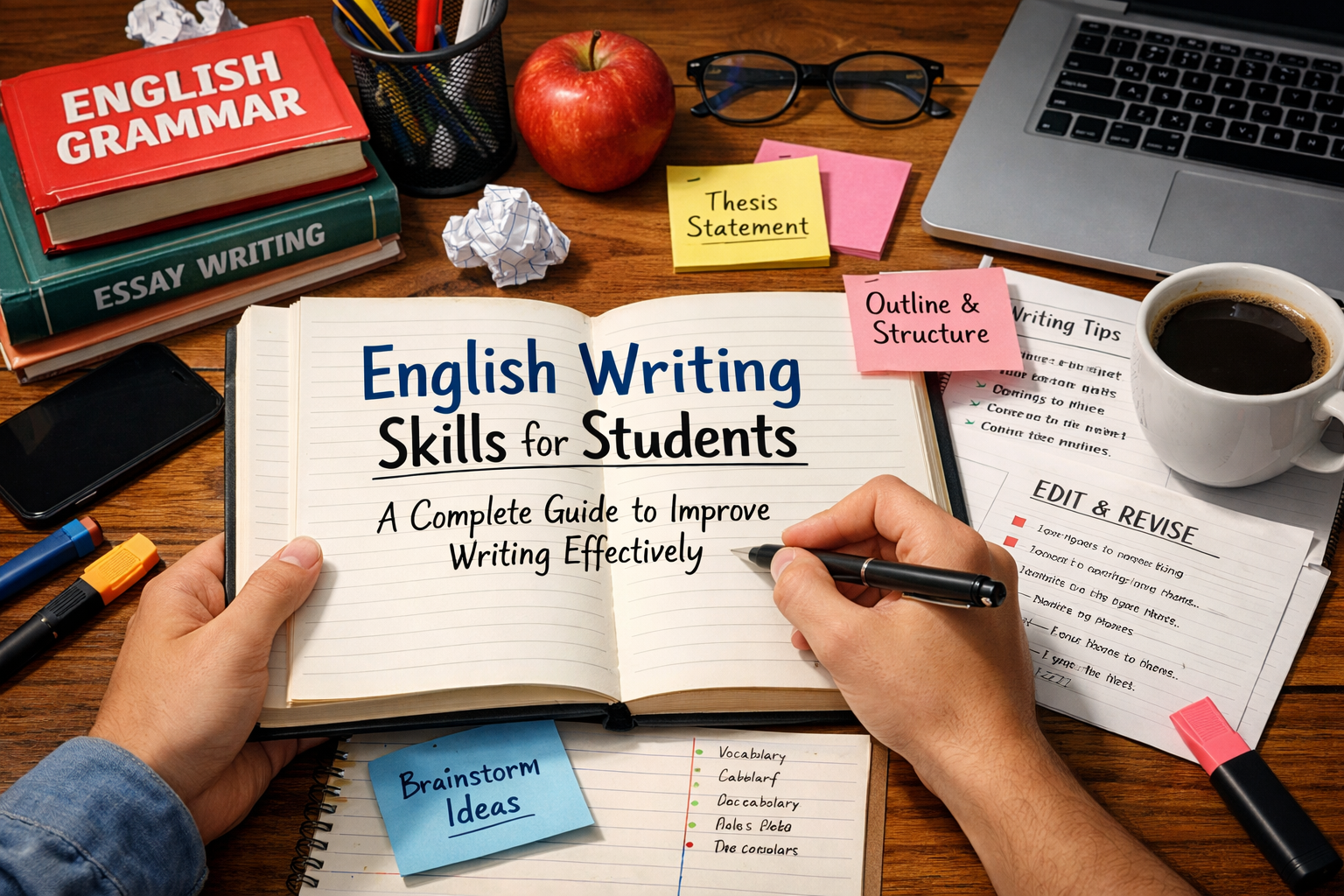


English writing skills are extremely important abilities that students need for academic success and future career growth. From school exams and college assignments to competitive tests and professional communication, writing English in a precise manner plays a vital role. However, many students struggle with grammar, sentence structure, vocabulary, and expressing ideas confidently in writing.
The good news is that English writing skills can be developed with the efficient techniques, regular practice, and guidance. In this comprehensive guide, you will learn why English writing is important, common mistakes students make, types of writing skills, and practical strategies to improvise English writing step by step.
Why English Writing Skills Are Important for Students
Strong English writing skills benefit students both academically and professionally.
1. Academic Performance
In schools and colleges, students are assessed through:
- Written exams
- Essays and assignments
- Project work
- Answer writing
- Vivas
Students with good writing skills can explain answers clearly, score higher marks, and present ideas effectively.
2. Competitive Exams
Many competitive exams test writing ability directly or indirectly, such as:
- Essay writing
- Letter or email writing
- Descriptive English sections
- Qualitative Aptitiudes
Examples include SSC, Banking exams, IELTS, TOEFL, and other entrance tests.
3. Better Communication Skills
Writing improves overall language clarity. Students who write well also:
- Speak more confidently
- Think logically
- Communicate ideas effectively
4. Career Growth
In professional life, writing skills are essential for:
- Emails and reports
- Resumes and cover letters
- Business communication
Students with strong English writing skills have better job opportunities and career advancement.
Common Challenges Students Face in English Writing
Understanding problems is the first step to improvement.
1. Weak Grammar Foundation
Many students struggle with:
- Tenses
- Articles (a, an, the)
- Subject-verb agreement
- Prepositions
- Other Parts of speech
2. Limited Vocabulary
A lack of vocabulary leads to repetitive and unclear writing.
3. Mother Tongue Influence
Thinking in the native language and translating into English often results in incorrect sentence structure.
4. Lack of Writing Practice
Students focus more on reading or speaking and neglect writing practice.
5. Fear of Making Mistakes
Fear reduces confidence and prevents students from writing freely.
Types of English Writing Skills Students Should Learn
To become confident writers, students should practice different forms of writing.
1. Sentence Writing Skills
Sentence writing is the foundation of all writing.
Students should learn:
- Simple sentences
- Compound sentences
- Complex sentences
Example:
❌ She going to school every day.
✅ She goes to school every day.
2. Paragraph Writing Skills
Paragraph writing helps students organize ideas logically.
A good paragraph includes:
- Topic sentence
- Supporting sentences
- Concluding sentence
Example Topics:
- Importance of Education
- My Favorite Teacher
- My Hobby
3. Essay Writing Skills
Essay writing is important for exams and academic success.
Common essay types:
- Descriptive essays
- Narrative essays
- Argumentative essays
- Opinion essays
A well-written essay has:
- Clear introduction
- Structured body paragraphs
- Strong conclusion
4. Letter and Email Writing Skills
Letter and email writing are essential for exams and real-life communication.
Students should learn:
- Formal letters (applications, complaints)
- Informal letters (friends, relatives)
- Professional email writing
Correct format and tone are crucial.
5. Story Writing Skills
Story writing improves creativity and imagination.
Key elements:
- Beginning, middle, and ending
- Characters and setting
- Logical flow of events

Effective Tips to Improve English Writing Skills for Students
1. Read Regularly
Reading improves writing naturally.
Recommended reading:
- English storybooks
- Newspapers
- Online articles and blogs
- Academic textbooks
Reading exposes students to correct grammar, vocabulary, and sentence patterns.
2. Build a Strong Vocabulary
A rich vocabulary improves writing quality.
Ways to improve vocabulary:
- Learn 5 new words daily
- Use a vocabulary notebook
- Learn synonyms and antonyms
- Use new words in sentences
Example:
Instead of very good, use excellent, outstanding, or remarkable.
3. Practice Grammar Daily
Grammar is the backbone of English writing.
Important grammar topics:
- Tenses
- Articles
- Prepositions
- Active and passive voice
- Direct and indirect speech
Grammar practice should be combined with writing application.
4. Write Every Day
Daily writing practice is essential for improvement.
Practice ideas:
- Maintain a daily journal
- Write short paragraphs on simple topics
- Describe daily activities in English
- Rewrite stories in your own words
Consistency is more important than perfection.
5. Think in English While Writing
Avoid translating from your mother tongue.
Simple practice:
- Describe surroundings in English
- Write thoughts in short English sentences
- Practice sentence formation mentally
6. Learn Common Sentence Structures
Practicing sentence patterns helps students write faster and accurately.
Examples:
- I like + noun/verb
- I want to + verb
- I believe that + sentence
7. Revise and Edit Your Writing
Editing improves writing quality.
Check for:
- Grammar mistakes
- Spelling errors
- Sentence clarity
- Word repetition
Good writers always revise their work.
English Writing Practice Activities for Students
1. Daily Writing Topics
Examples:
- My Best Friend
- A Memorable Day in My Life
- My Favorite Book
- My Future Goal
2. Picture-Based Writing
Describe:
- What you see
- Who is involved
- What is happening
This improves creativity and observation skills.
3. Sentence Expansion Exercises
Example:
She is reading.
→ She is reading an interesting book in the library.
4. Error Correction Practice
Correcting mistakes strengthens grammar understanding.
Example:
❌ He do not like tea.
✅ He does not like tea.
Common English Writing Mistakes Students Should Avoid
- Writing long and confusing sentences
- Ignoring punctuation
- Overusing difficult words
- Repeating the same words frequently
- Not revising after writing
Simple and clear writing is always better than complex writing.
How Parents and Teachers Can Support Writing Skills
- Encourage daily writing habits
- Appreciate effort, not only accuracy
- Correct mistakes gently
- Provide reading materials
- Create a positive learning environment
Confidence grows with encouragement.
Exam-Oriented English Writing Tips for Students
- Understand the question clearly
- Plan before writing
- Maintain proper format
- Write simple and clear sentences
- Leave time for revision
Conclusion
English writing skills for students are essential for academic success, confidence, and future careers. While grammar and vocabulary are important, regular practice, reading, and confidence are the real keys to mastering English writing. Students should not fear mistakes, as mistakes are a natural part of learning.
By practicing daily, thinking in English, and revising regularly, students can improve their writing skills significantly. With patience and consistency, English writing can become a strong skill rather than a challenge.


